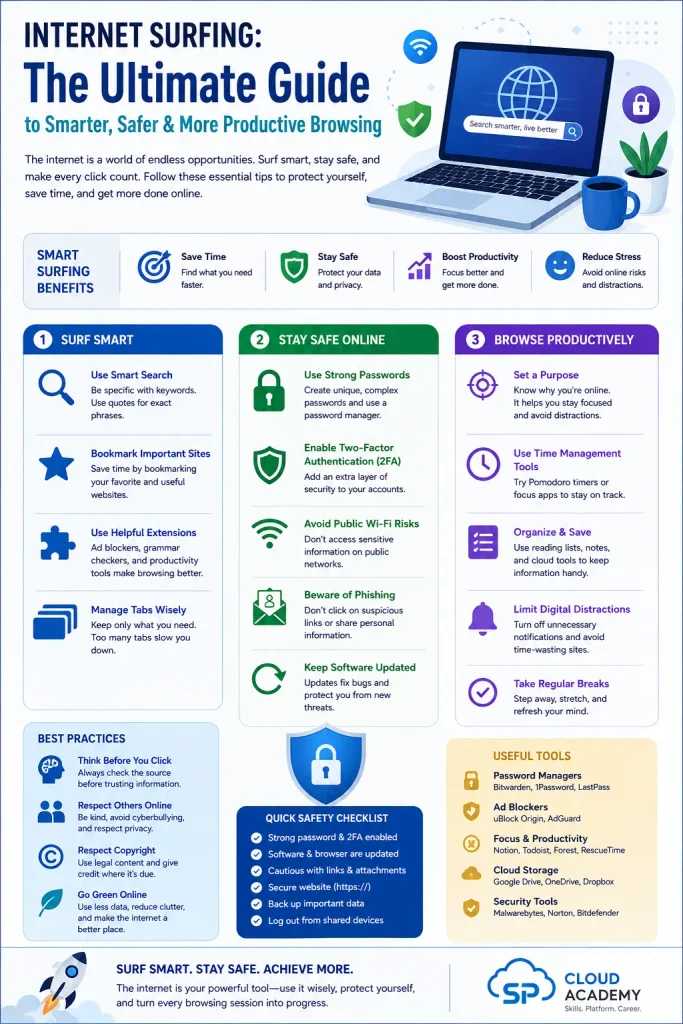
Most of us spend hours online every single day, yet very few of us ever stop to think about how we actually surf the internet. We click, we scroll, we open a dozen tabs we’ll never read, and somewhere along the way we pick up slow browsers, cluttered bookmarks, and a nagging sense that our data isn’t as private as we’d like it to be. Internet surfing has quietly become one of the most important digital skills of our time — and like any skill, it can be done well or done poorly.
This guide breaks down what smarter, safer, and more productive browsing actually looks like in practice. Whether you’re a student researching a thesis, a professional juggling dozens of browser tabs, or simply someone who wants to stop feeling overwhelmed every time you open a new window, you’ll find practical, easy-to-apply advice here — no jargon, no fluff, just what works.
What Is Internet Surfing, Really?
“Internet surfing” (sometimes called web browsing) simply means navigating from one web page to another, usually by following links, using a search engine, or typing addresses directly into a browser. The term dates back to the early days of the web, when moving between pages felt a bit like riding a wave from one site to the next.
Today, surfing the internet involves far more than passive clicking. It includes searching for information, comparing products, watching videos, managing email, using web apps, and interacting on social platforms — all through a browser that has become one of the most-used pieces of software on any device. Understanding how your browser works, and how to control it, is the first step toward surfing smarter.
Why Smarter Browsing Matters in 2026
The web has grown more complex, more data-hungry, and more crowded with distractions than ever before. A few realities make smarter browsing genuinely necessary rather than a nice-to-have:
- Websites load more scripts, trackers, and ads than they did even a few years ago, which slows down browsing and drains battery life.
- Cyber threats such as phishing pages, malicious extensions, and fake login forms are increasingly convincing and harder to spot.
- Data collection has expanded, with dozens of trackers often running silently in the background of a single page visit.
- Constant notifications, autoplay videos, and infinite scroll are specifically designed to pull attention away from what you actually opened the browser to do.
The good news is that a handful of deliberate habits and settings changes can address all four of these problems at once — and that’s exactly what the rest of this guide covers.
Choosing the Right Browser for Your Needs
Not all browsers are built the same way, and the “best” one depends on what you value most: raw speed, maximum privacy, extension support, or battery efficiency. Here’s a quick side-by-side comparison of the most widely used options.
| Browser | Best For | Speed | Privacy | Extensions |
| Google Chrome | Overall performance, wide compatibility | Excellent | Moderate | Huge library |
| Mozilla Firefox | Privacy-conscious users | Very Good | Strong | Extensive |
| Microsoft Edge | Windows users, productivity tools | Excellent | Moderate | Chrome-compatible |
| Brave | Built-in ad and tracker blocking | Very Good | Excellent | Chrome-compatible |
| Apple Safari | Mac and iOS battery efficiency | Excellent | Strong | Limited but growing |
There is no single “correct” browser for everyone. Many power users actually keep two browsers installed — one for everyday browsing and one dedicated to sensitive tasks like online banking, kept extension-free and logged out of unnecessary accounts.
Speed Up Your Browsing: Practical Optimization Tips
A sluggish browser is rarely the browser’s fault alone. In most cases, speed problems come from accumulated clutter and unnecessary background activity. Try these fixes, roughly in order of impact:
- Close unused tabs. Each open tab consumes memory and, in many cases, continues running background scripts even when you’re not looking at it.
- Clear your cache and cookies periodically. A bloated cache can actually slow page loading rather than speed it up, especially after months of accumulation.
- Audit your extensions. Every installed extension adds a small amount of overhead; disable or remove anything you haven’t used in the last month.
- Enable hardware acceleration in your browser settings so graphics-heavy pages are rendered by your GPU instead of your CPU.
- Keep your browser updated. Each release typically includes performance improvements and security patches, not just new features.
- Use a lightweight new-tab page. Heavily animated or widget-filled new-tab pages can add noticeable delay every time you open a tab.
Together, these small adjustments can noticeably cut page-load times and free up system resources — often more effectively than buying new hardware.
Browser Extensions Worth Installing
A well-chosen set of extensions can transform a basic browser into a genuinely powerful productivity and safety tool. A few categories worth considering:
- Ad and tracker blockers, which reduce page clutter, speed up loading, and limit the amount of data collected about you.
- Password managers, which generate and store strong, unique passwords so you’re never tempted to reuse the same one everywhere.
- Tab managers, which group, suspend, or bookmark tabs in bulk so an overloaded tab bar never grinds your system to a halt.
- Reading-mode or article-view tools, which strip ads and pop-ups from long-form content so you can actually focus on reading.
- Grammar and writing assistants, useful for anyone drafting emails, articles, or messages directly in the browser.
One caution worth repeating: install extensions only from official browser stores, check their permissions before enabling them, and periodically review what’s installed. Extensions with broad permissions can, in rare cases, be repurposed to track activity or inject unwanted content.
Staying Safe Online: Essential Security Practices
Safe browsing isn’t about being paranoid — it’s about building a small set of habits that dramatically reduce your exposure to common threats.
Recognize and Avoid Phishing Attempts
Phishing pages are designed to look like legitimate login screens for banks, email providers, or social platforms. Before entering credentials anywhere, check that the URL matches the real domain exactly, look for the padlock icon indicating a secure HTTPS connection, and be suspicious of unexpected urgency (“Your account will be suspended in 24 hours”).
Keep Software and Browsers Updated
Security patches close vulnerabilities that attackers actively look for. Enabling automatic updates for your browser and operating system removes the guesswork and ensures you’re protected as soon as a fix is available.
Use Strong, Unique Passwords Everywhere
Reusing passwords across sites means a single data breach can compromise multiple accounts. A password manager solves this by generating and remembering strong, unique credentials for every site you visit.
Enable Two-Factor Authentication
Two-factor authentication (2FA) adds a second verification step — typically a code sent to your phone or generated by an app — so a stolen password alone isn’t enough to access your account.
Be Careful on Public Wi-Fi
Public networks in cafes, airports, and hotels are convenient but often unsecured. Avoid logging into sensitive accounts on public Wi-Fi unless you’re using a trusted VPN, and disable file sharing on your device while connected.
Protecting Your Privacy While You Surf
Security and privacy overlap but aren’t identical. Security keeps bad actors out; privacy limits how much legitimate companies can learn about you. A few effective habits:
- Use private or incognito browsing windows when you don’t want a session’s history or cookies saved locally.
- Review and limit cookie consent on websites rather than accepting all trackers by default.
- Adjust your browser’s privacy settings to block third-party cookies and cross-site tracking.
- Consider a reputable VPN when using unfamiliar or public networks, which encrypts your traffic and masks your IP address.
- Periodically check which sites have access to your camera, microphone, and location, and revoke permissions you no longer need.
None of these steps make you invisible online, but together they meaningfully reduce the amount of data collected about your browsing habits.
Productivity Hacks for Focused Browsing
The internet is designed to be engaging, which is exactly why it’s so easy to open one tab for research and end up thirty minutes later reading something completely unrelated. A few strategies can help you stay on task:
- Use tab groups to visually separate work, research, and personal browsing so context switching is less jarring.
- Try a website blocker during focused work sessions to temporarily restrict distracting sites.
- Adopt the “one tab, one task” rule — if a new tab isn’t related to your current goal, bookmark it for later instead of opening it immediately.
- Turn off non-essential browser notifications, which are one of the most common sources of unplanned distraction.
- Batch small browsing tasks (checking news, social media, personal email) into scheduled windows rather than letting them interrupt deep work throughout the day.
Small structural changes like these tend to be far more sustainable than relying on willpower alone.
Mobile vs Desktop Browsing: What Changes
Mobile browsing now accounts for the majority of web traffic worldwide, but the experience isn’t identical to desktop browsing, and neither are the risks.
On mobile, screen space is limited, so tab overload becomes disorienting faster, and it’s easier to tap a malicious link or pop-up by accident. On the other hand, mobile browsers often include stronger sandboxing between apps, and biometric authentication (fingerprint or face recognition) adds a convenient security layer that most desktops lack by default.
A practical approach is to treat mobile browsing with the same caution as desktop: avoid installing browser apps from outside official app stores, keep your mobile browser updated, and be extra cautious about entering sensitive information into pop-ups or unfamiliar sites while on the go.
Common Internet Surfing Mistakes to Avoid
- Ignoring browser update prompts for weeks or months, leaving known vulnerabilities unpatched.
- Clicking links in unexpected emails or messages without hovering to check the actual destination URL.
- Saving passwords in plain browser autofill without a master password or additional protection.
- Downloading software or extensions from unofficial, third-party sites instead of official stores.
- Leaving dozens of tabs open indefinitely, which slows the system and makes it harder to find what actually matters.
- Accepting every cookie and permission prompt without reading what’s being requested.
Frequently Asked Questions
Is internet surfing the same as web browsing?
Yes, the two terms are used interchangeably to describe navigating web pages using a browser.
What is the safest browser to use?
There isn’t a single universally “safest” browser — Firefox and Brave are often praised for privacy-focused defaults, while Chrome and Edge offer strong built-in phishing and malware protection. The safest setup depends on how you configure whichever browser you choose.
Does clearing my cache actually improve browsing speed?
It can, especially if the cache has grown very large over time, though the improvement is usually modest compared to closing unused tabs and removing unnecessary extensions.
Do I need a VPN for everyday browsing?
Not necessarily for everyday home browsing, but a VPN is genuinely useful on public Wi-Fi or when you want to limit what your internet provider can see about your traffic.
How many browser extensions is too many?
There’s no fixed number, but a good rule of thumb is to keep only the extensions you actively use at least weekly, and to review the full list every few months.
Conclusion
Smarter, safer, and more productive internet surfing doesn’t require a technical background — it requires a handful of intentional habits repeated consistently. Choose a browser that fits how you actually use the web, trim the clutter of unused tabs and extensions, build basic security practices into your routine, and set up your environment to work with your focus rather than against it.
The internet isn’t going to slow down or get simpler on its own. But with the right setup and a bit of awareness, you can browse it faster, more safely, and with far less friction than most people ever bother to achieve.
Related Posts
-

Internet Surfing: The Ultimate Guide to Smarter, Safer & More Productive Browsing
-

Audiobooks vs Podcasts: Which Makes You Smarter? Science Has Answers
-

Microsoft Edge vs Chrome vs Firefox in 2025: Which Browser Is Truly Winning the Internet?
-

WhatsApp 2025 Ultimate User Manual: Hidden Features, Tips & Tricks Revealed
-

Voice Typing Made Easy: Expert Tips & Tricks for Perfect Hands-Free Writing
-

Top 7 Best Password Managers You Need to Protect Your Online Identity