A Comprehensive Guide to Integrating Technology, People, and Resources for Modern, Future-Ready Education
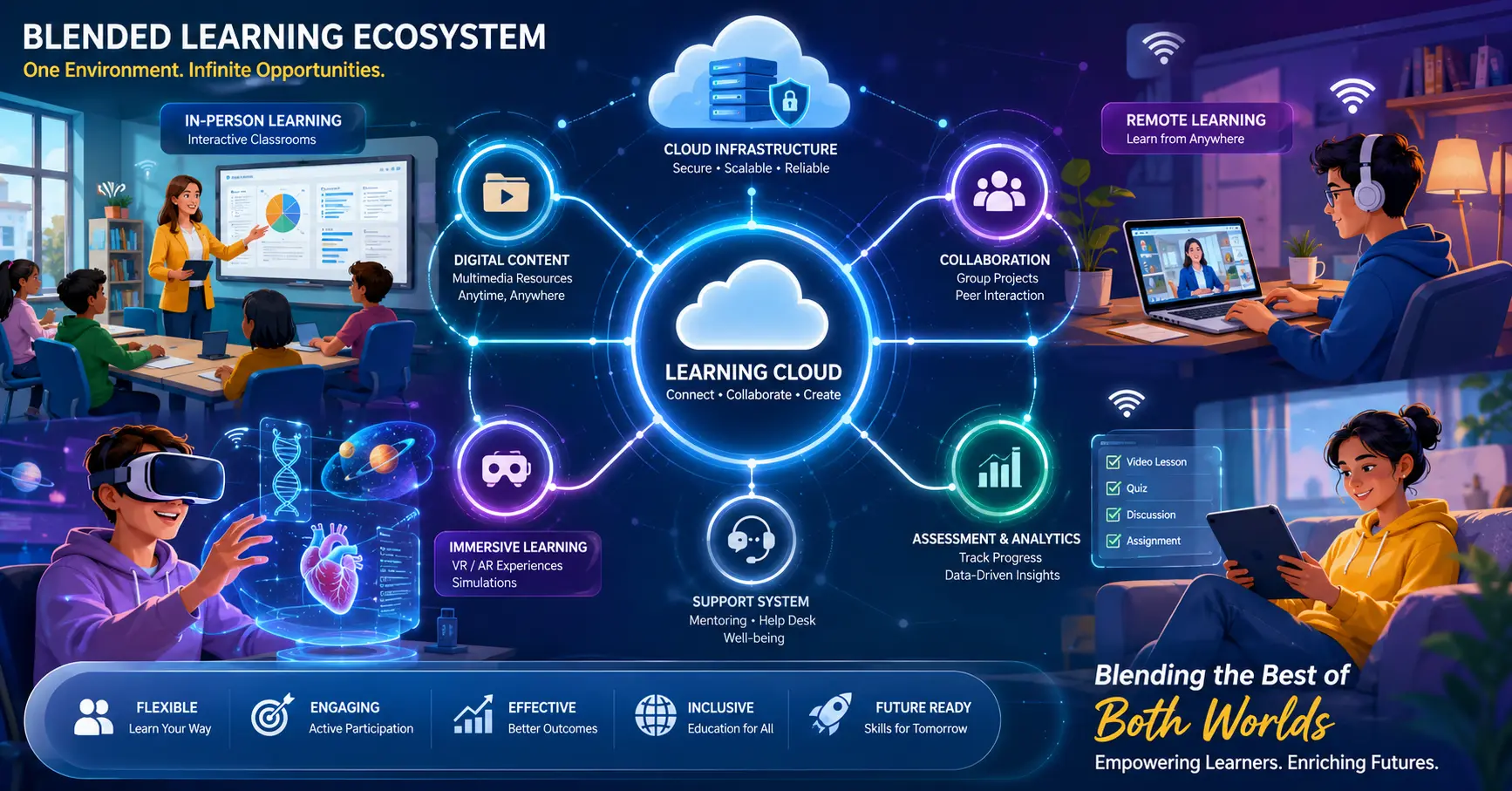
Education has evolved far beyond the four walls of a traditional classroom. Today, the most effective educational frameworks rely on a holistic approach that brings together advanced digital tools, dedicated educators, and comprehensive resources. This synergy is known as the blended learning ecosystem — a dynamic environment designed to offer flexible, personalized, and highly engaging experiences for every learner, from primary school to university and professional upskilling.
Institutions that get this right don’t simply bolt software onto old routines. They design a coherent architecture in which a Learning Management System, cloud infrastructure, virtualization, AI services, security, and analytics all work together — supporting administrators, teachers, and students in a single connected experience. This comprehensive guide walks through every layer of that architecture: the core technology pillars, the access and delivery models, the online teaching frameworks for technical subjects, the AI-driven services that personalize learning, and the next-generation, engineering-grade ecosystems that will define education through 2026 and beyond.
1. Understanding the Blended Learning Ecosystem
At its core, a robust educational framework achieves the perfect integration of three learning modes: Face-to-Face Learning, Online Learning, and Virtual Learning. Where these three circles overlap, a holistic “blended learning” experience emerges — one that offers unparalleled flexibility, immediate feedback, and continuous improvement.

| Learning Mode | What It Delivers | Typical Components |
| Face-to-Face Learning | Direct human interaction and immediate feedback in a physical setting. | In-person instruction, classroom discussions, practical activities, hands-on demonstrations |
| Online Learning | Self-paced, anywhere access to structured coursework. | LMS courses, recorded lectures, multimedia content, continuous online assessment |
| Virtual Learning | Safe, simulated environments for experimentation without real-world risk. | Virtual labs, remote desktops, simulations, safe experimentation sandboxes |
This ecosystem is built on a set of core technology pillars that work in concert:
| Pillar | Purpose | Examples |
| Learning Management System (LMS) | Central platform for courses, assignments, and communication. | Course management, assessments, gradebook, discussion forums |
| Cloud Computing | Anytime, anywhere access to resources and storage. | Cloud storage, SaaS/PaaS/IaaS, collaboration tools |
| Virtualization Technologies | Hands-on, risk-free practice environments. | Virtual labs, remote desktops, digital twins |
| Social Media & Collaboration | Engagement and community building beyond the classroom. | Discussion boards, group chat, peer learning communities |
| E-Library | On-demand access to reference and research material. | Digital books, journals, videos, research repositories |
| National Broadcasting Media (NBM) | Extends reach through mass media channels. | TV, radio, and educational broadcast programming |
| Electronic Distribution Media (EDM) | Delivers content where connectivity is limited. | USB drives, SD cards, offline servers |
| Inspiration & Initiative | The human element that sustains motivation and drives adoption. | Mentorship, success stories, institutional leadership |
Whether students are accessing materials via the internet, offline through Electronic Distribution Media, or in traditional classrooms with updated safety protocols, the goal remains the same: equitable, flexible, and lifelong learning for every student.
2. Learning Delivery and Access Models
A mature blended ecosystem doesn’t assume every learner has the same connectivity or environment. Instead, it offers three parallel access models so that no student is left behind.
| Access Model | Individual Access | Group Access |
| Online Access (via Internet) | LMS courses, recorded lectures, assignments, online exams | Live classes, video conferencing, discussion forums, collaborative projects |
| Offline Access (via EDM) | Offline LMS packages, downloaded videos, eBooks/PDFs, practice materials | Computer labs, offline servers, community centers, shared devices |
| Traditional (New Normal) | In-person classroom with safety protocols | Hybrid attendance (online + in-person), limited occupancy, health & wellbeing first |
This tiered model is what makes blended learning genuinely inclusive: a student with a stable broadband connection, one relying on downloaded offline packages, and one attending a physical classroom can all progress through the same curriculum on equal footing.
3. The Role of a Unified Learning Management System (LMS)
A disjointed digital experience can hinder both teaching and learning. To combat this, modern institutions rely on a centralized hub. A unified LMS core platform — whether built on Moodle, Canvas, or Microsoft Teams — connects the distinct activities of administrators, teachers, and students into one seamless system, and links out to the institution’s website, admissions portal, and parent communications.

- Administrators: Manage systems and users, monitor performance, oversee reports & analytics, and enforce policy & security across the platform.
- Teachers: Create and manage courses, deliver lessons, assess and grade student work, and support students directly through feedback and communication.
- Students: Access courses, learn and collaborate, submit assignments, and track their own progress and grades in real time.
A well-designed LMS core platform typically bundles the following capabilities:
| Capability | What It Enables | Institutional Benefit |
| Course & User Management | Multi-level roles for admin, teacher, student, and guest | Centralized control and clean enrollment workflows |
| Assessments & Gradebook | Quizzes, exams, rubrics, auto-grading, transcripts | Consistent, auditable evaluation |
| Content & SCORM/xAPI/LTI Support | Interactive eBooks, multimedia, third-party content packages | Reusable, standards-based content |
| Discussion Forums & Messaging | Peer and teacher-student communication | Stronger engagement and community |
| Analytics & Reporting | Attendance, performance, and predictive dashboards | Data-driven institutional decisions |
| Certificates & Digital Badges | Verifiable completion credentials | Recognized, shareable achievement |
By integrating with tools like Microsoft 365, Google Workspace, and SSO identity providers, the LMS transforms from a simple course repository into a smart, secure, and scalable environment that drives data-driven decisions across the whole institution — from primary schools to universities.
4. Architecting an Online Teaching Model for Technical Skills
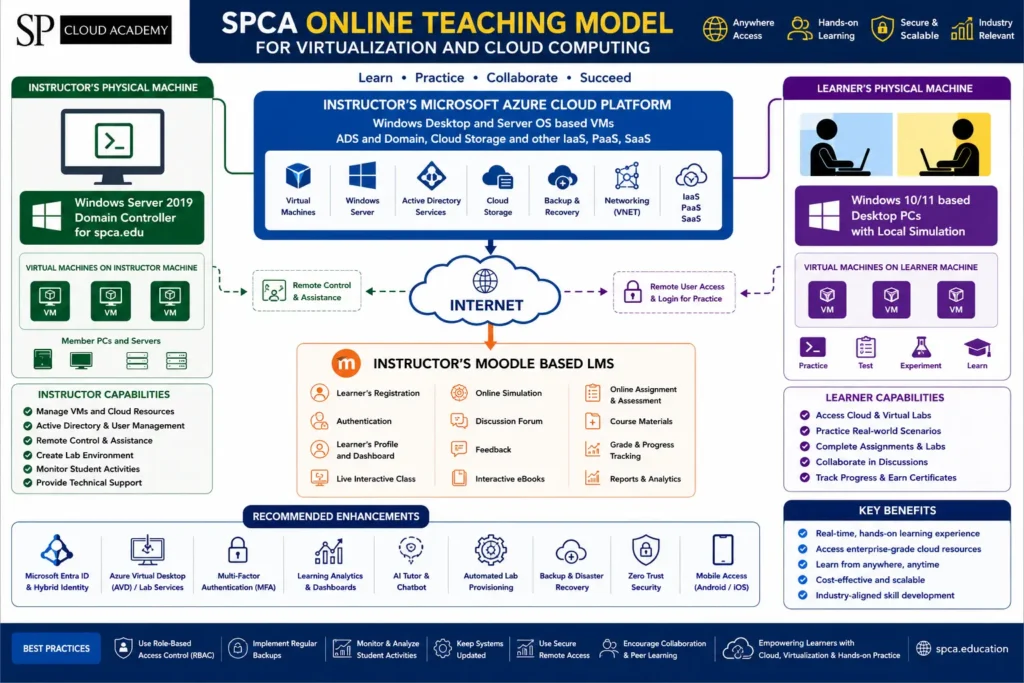
Teaching highly technical subjects — such as cloud computing, virtualization, or network engineering — requires infrastructure that goes well beyond a standard LMS. A powerful framework for virtualization and cloud-based instruction pairs enterprise-grade cloud resources on the instructor’s side with lightweight, everyday hardware on the learner’s side.
How the Model Works
An instructor utilizes a Microsoft Azure cloud platform to host Windows Desktop and Server OS-based virtual machines, Active Directory Domain Services, cloud storage, backup and recovery, and virtual networking (VNet). On top of this, an instructor-managed, Moodle-based LMS handles learner registration, authentication, live interactive classes, online simulations, assignments, and progress tracking.
Learners, meanwhile, need nothing more elaborate than a standard Windows 10 or 11 desktop or laptop. They connect to the instructor’s cloud environment over the internet for remote, secure access, running their own set of virtual machines for practice, testing, and experimentation — without ever putting production systems at risk.
| Role | Key Capabilities | Outcome |
| Instructor | Manage VMs & cloud resources, Active Directory & user management, remote assistance, monitor student activity | Full control over lab environments and real-time support |
| Learner | Access cloud & virtual labs, practice real-world scenarios, complete assignments, collaborate in discussions | Hands-on, industry-aligned skill development |
| Recommended Enhancements | MFA, Azure Virtual Desktop, learning analytics, AI tutor/chatbot, automated lab provisioning, Zero Trust security | A secure, cost-effective, and scalable teaching environment |
This setup allows students to practice real-world scenarios securely over the internet via remote user access, while instructors manage lab environments and monitor student activity in real time. It is a highly cost-effective and scalable way to build industry-aligned skills, since institutions avoid the capital expense of dedicated physical lab hardware for every learner.
5. Powering the Ecosystem with AI and Smart Integrations
To make learning truly engaging, institutions must layer intelligent services over their cloud infrastructure. A modern smart ecosystem utilizes AI services to provide personalized learning paths, automated feedback, and always-available AI tutors and chatbots — turning what used to be a static course catalog into a responsive, adaptive experience.
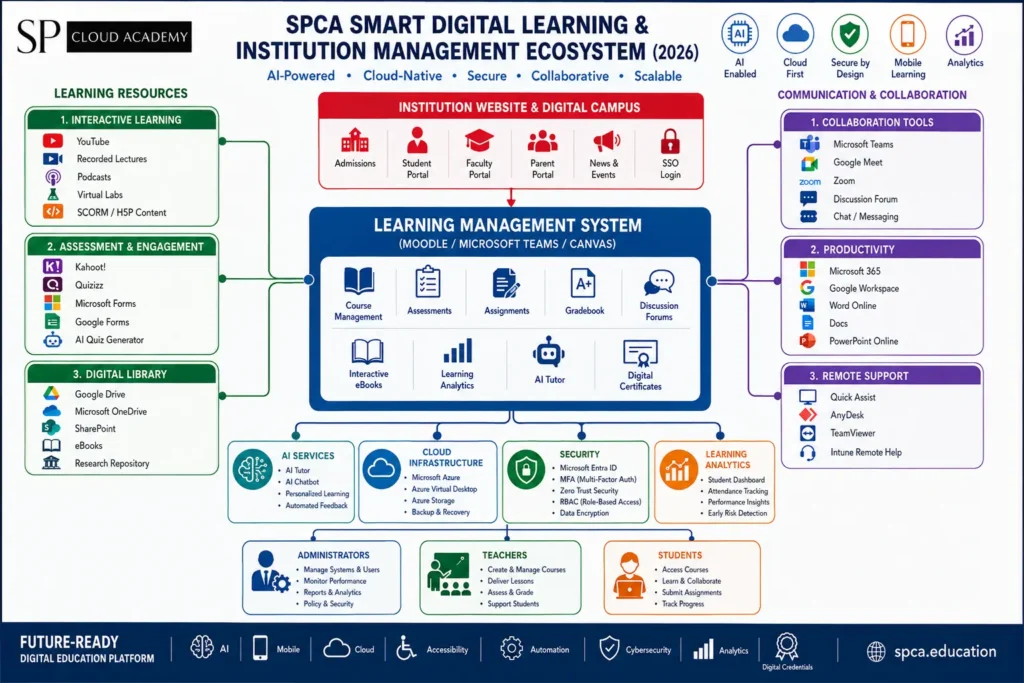
This smart ecosystem connects interactive learning resources — including video lectures, podcasts, virtual labs, and SCORM/H5P content — directly to the LMS. Assessment and engagement tools such as quizzes, AI quiz generators, and interactive forms keep learners active rather than passive. Seamless integration with communication tools like Microsoft Teams, Zoom, and Google Meet fosters a highly collaborative environment, while deep learning analytics offer early risk detection, attendance tracking, and performance insights so that struggling students are identified before they fall behind.
| AI/Smart Layer | Function | Impact on Learning |
| AI Tutor & Chatbot | On-demand, conversational academic support | Reduces response time for student questions |
| Personalized Learning | Adapts pacing and content to individual performance | Improves mastery and retention |
| Automated Feedback & Grading | Instantly evaluates quizzes and assignments | Frees teacher time for higher-value coaching |
| Learning Analytics | Dashboards, predictive insights, early risk detection | Enables timely, data-driven intervention |
| Content Generation | Assists in building lessons, quizzes, and materials | Speeds up course development |
6. Security, Identity, and Institutional Administration
As more of the teaching and learning experience moves onto connected platforms, security and identity management become foundational rather than optional. A mature ecosystem is built on Zero Trust principles: every user and device is verified, every session is encrypted, and access is granted on a least-privilege basis.
- Identity: Multi-Factor Authentication (MFA) and Single Sign-On (SSO) to simplify and secure logins across every connected tool.
- Access Control: Role-Based Access Control (RBAC), endpoint protection, and encrypted data at rest and in transit.
- Continuity: Automated backup and disaster recovery to protect institutional and student data.
- Compliance: Alignment with recognized frameworks such as ISO 27001 and GDPR-ready data handling practices.
On the administrative side, dashboards built on tools like Power BI give institutional leaders visibility into student analytics, faculty analytics, predictive learning trends, and institutional reporting — turning the LMS from a teaching tool into a genuine management system for the whole institution.
7. The Future: Next-Generation Engineering Learning (2026 and Beyond)

Looking ahead, technical and engineering education is moving toward AI-powered, cloud-native, secure, and scalable frameworks purpose-built for STEM disciplines. These next-generation ecosystems organize the entire student journey into a clear, repeatable pipeline:
| Stage | Focus | Supporting Technology |
| Content Creation | Building structured, reusable course material | Articulate 360, Adobe Captivate, iSpring, H5P, SCORM/xAPI |
| Learning Delivery | Distributing content across devices and channels | LMS, cloud infrastructure, mobile-first design |
| Collaboration | Peer and instructor interaction | Discussion forums, Teams, social learning, group projects |
| Virtual Practice | Hands-on experimentation without physical risk | Browser labs, VMs, containers, digital twins, networking labs |
| Assessment | Measuring competency and understanding | Quizzes, exams, rubrics, auto-grading, remote proctoring |
| Certification | Recognizing achievement | Digital badges and verifiable certificates |
| Analytics & Improvement | Closing the loop for continuous improvement | Dashboards, predictive learning, institutional reports |
A standout feature of these frameworks is the heavy reliance on virtual labs and simulation — encompassing browser-based labs, virtual machines, containers, digital twins, networking labs, cloud labs, and AI labs. These environments let complex engineering principles be tested safely and repeatedly, and they’re accessible across a wide range of supported devices, from desktops and laptops to tablets, smartphones, and VR headsets.
These ecosystems are typically built to recognized technology standards — SCORM, xAPI, LTI, WCAG 2.2 accessibility, ISO 27001, and GDPR readiness — ensuring content is portable, accessible, and secure by design.
8. Modern Enhancements Worth Adopting
Institutions that have already established the core pillars above can further differentiate their offering with a set of modern, high-impact enhancements:
| Enhancement | What It Adds |
| AI & Adaptive Learning | AI tutors, personalized recommendations, and adaptive assessments that adjust to each learner |
| Microlearning | Short, focused lessons that improve retention and flexibility |
| Gamification | Badges, leaderboards, and rewards that boost engagement |
| VR / AR & Simulation | Immersive experiences for practical, real-world learning |
| Open Educational Resources (OER) | Reduces cost and increases access to quality material |
| Cybersecurity & Privacy | Secures data, protects identities, and ensures compliance |
| Accessibility & Inclusion | Accessible content for learners with diverse needs (WCAG 2.2) |
| Mobile Learning | Learn anytime, anywhere, using smartphones and tablets |
9. Assessment Strategy
A comprehensive ecosystem doesn’t rely on a single style of evaluation. Instead, it blends multiple assessment strategies so that both knowledge and applied competency are measured fairly:
- Formative Assessment: Ongoing quizzes and check-ins that guide instruction in real time.
- Summative Assessment: Exams and final projects that measure overall achievement.
- Competency-Based Assessment: Evaluating demonstrated skills against defined competency standards.
- Project-Based Assessment: Real-world projects that show applied understanding.
- Peer & Self-Assessment: Structured self-review and peer feedback that build reflective learning habits.
10. Benefits and Outcomes
When technology, people, and resources are integrated thoughtfully, the payoff shows up across the whole institution, not just in the classroom:
| Benefit | For Learners | For Institutions |
| Flexibility | Learn anytime, anywhere, at an individual pace | Serve a wider, more diverse student base |
| Engagement | More interactive, personalized experiences | Higher retention and satisfaction rates |
| Cost Efficiency | Lower cost access to enterprise-grade tools | Reduced physical infrastructure spend |
| Data-Driven Improvement | Faster, more targeted support | Evidence-based curriculum and policy decisions |
| Equity & Inclusion | Multiple access paths regardless of connectivity | Broader reach across underserved communities |
| Industry Alignment | Skills that map directly to real-world tools | Stronger graduate outcomes and employability |
11. Common Challenges and How to Address Them
Building a blended ecosystem is not without friction. Institutions typically encounter a predictable set of challenges — and each has a proven mitigation path:
| Challenge | Mitigation |
| Uneven internet connectivity among students | Offer offline access via EDM (downloadable packages, offline servers, community computer labs) |
| Teacher unfamiliarity with new tools | Structured onboarding, ongoing professional development, and an AI assistant for day-to-day questions |
| Data privacy and security concerns | Zero Trust architecture, MFA, RBAC, encryption, and compliance with ISO 27001/GDPR |
| Fragmented tools and duplicate logins | Consolidate around a unified LMS with SSO and deep third-party integrations |
| Difficulty measuring real impact | Adopt learning analytics dashboards with predictive insights and regular reporting cadences |
| Budget constraints for lab hardware | Shift to cloud-hosted virtual labs and virtualization rather than physical lab investment |
12. A Practical Implementation Roadmap
Institutions moving from a traditional or partially digital setup toward a full blended learning ecosystem generally succeed by sequencing the work rather than attempting everything at once:
- Step 1 — Establish the Core Platform: Select and configure a unified LMS, migrate existing course content, and establish clear roles for administrators, teachers, and students.
- Step 2 — Build the Cloud & Security Foundation: Stand up cloud storage, SSO, and baseline security (MFA, RBAC, backup & recovery) before scaling usage.
- Step 3 — Add Virtualization and Practice Environments: Introduce browser-based or VM-based virtual labs for hands-on, technical subjects.
- Step 4 — Introduce AI and Analytics: Layer in AI tutors, automated grading, and analytics dashboards once the base platform is stable.
- Step 5 — Extend Offline and Hybrid Access: Publish offline content packages and equip computer labs or community centers for students with limited connectivity.
- Step 6 — Layer in Enhancements: Add gamification, microlearning, OER, and VR/AR experiences based on what learner data shows is needed.

This phased approach keeps the rollout manageable, lets teams learn from each stage, and ensures the ecosystem is genuinely adopted rather than merely installed.
Conclusion
Building a complete blended learning ecosystem is not simply about adopting new software; it is about thoughtfully integrating technology, people, and resources into one coherent architecture. A unified LMS ties together administrators, teachers, and students. Cloud infrastructure and virtualization make technical, hands-on learning possible from anywhere. AI services personalize the experience and lighten the workload on educators. Robust security and analytics keep the whole system trustworthy and continuously improving. And multiple access models — online, offline, and traditional — ensure that no learner is excluded because of where they live or what device they own.
Institutions that commit to this integrated approach create environments that are not only efficient, secure, and scalable, but deeply engaging and genuinely student-centric. The future of learning is blended, boundless, and brighter than ever.
Frequently Asked Questions
What is a blended learning ecosystem?
It is an educational framework that integrates face-to-face, online, and virtual learning through a unified technology stack — including an LMS, cloud infrastructure, virtualization, AI services, and security — supported by dedicated educators and comprehensive learning resources.
Is a blended learning ecosystem only for universities?
No. The same core architecture scales from primary schools to universities and corporate or professional training programs, with the depth of virtualization and technical infrastructure adjusted to the subject matter and learner age group.
How does a blended ecosystem support students with limited internet access?
Through Electronic Distribution Media (EDM) — offline LMS packages, downloaded videos, eBooks, and shared computer labs — alongside traditional broadcast media, so learning continues even where connectivity is unreliable.
What role does AI play in a blended learning ecosystem?
AI powers personalized learning paths, automated grading and feedback, AI tutors and chatbots, and predictive analytics that flag at-risk students early — all layered on top of the core cloud and LMS infrastructure.
See Also
-
THE COMPLETE BLENDED LEARNING ECOSYSTEM
-

The Ultimate Guide to Developing an E-Learning Studio for Engineering Institutes: From Planning to Production
-

How Smartphones Are Transforming Blended Teaching into a Classroom Superpower!
-

From Desktop to Cloud: The Revolutionary Shift That’s Making Physical Computing Labs Obsolete in 2025
-
Master Google Classroom Like a Pro: The Complete Training Guide for Teachers
-
Revolutionizing LMS: How Simulation & Virtual Tech Are Changing Online Learning Forever
-
Unlocking Creativity with Miro: A Comprehensive User’s Handbook
-
LMS vs. Traditional Online Learning: Which One Will Dominate the Future?
-
Personalized Learning Made Simple: The Ultimate Tools for Educators