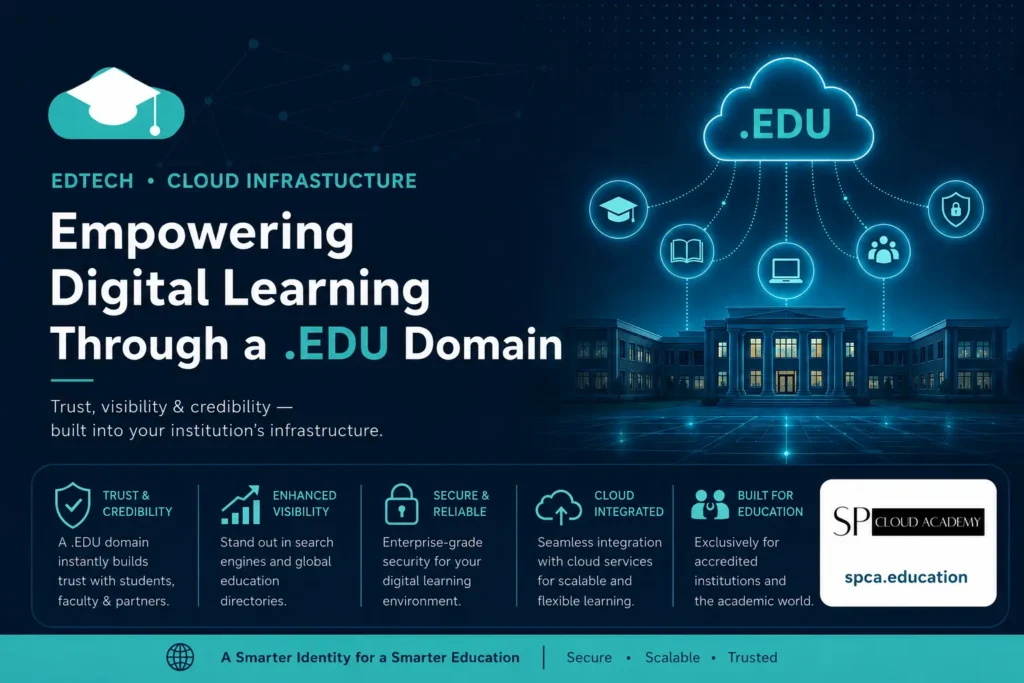
A .edu domain is more than an address. It is a credential in itself. Restricted to accredited, degree-granting postsecondary institutions in the United States, it signals authenticity, academic legitimacy, and trust to students, faculty, researchers, and search engines alike. For any institution operating in the digital learning economy of 2026, holding and correctly leveraging a .edu domain remains one of the most cost-effective ways to build credibility while unlocking a substantial ecosystem of free and discounted technology from the world’s largest software and cloud vendors.
This guide rewrites and updates the earlier SP Cloud Academy overview of the .edu domain, correcting outdated vendor details, folding in program changes that took effect through mid-2026, and reorganizing the material into a cleaner, SEO-friendly reference for administrators, IT teams, and students.
Table of Contents
- 1. Why the .edu Domain Still Matters in 2026
- 2. Who Actually Qualifies for a .edu Domain
- 3. Institutional Benefits of Owning a .edu Domain
- 4. What a .edu Email Account Unlocks for Students
- 5. 2026 Update: What Changed Across Major Vendor Programs
- 6. Vendor-by-Vendor Snapshot: Education Programs at a Glance
- 7. Free University Courses Anyone Can Access
- 8. Internship Pathways from Leading Tech Companies
- 9. How to Make the Most of a .edu Account
- 10. Final Thoughts
1. Why the .edu Domain Still Matters in 2026
The .edu top-level domain has been reserved for accredited, degree-granting postsecondary institutions since 2001, when the registry passed from the U.S. government to Educause, the nonprofit that continues to administer it today. That single restriction is the source of everything valuable about the domain: because anyone browsing the web can be confident that a .edu address belongs to a legitimate school, the extension carries an implicit stamp of accreditation that no amount of marketing can replicate on a .com or .org site.
That trust translates into measurable advantages. Search engines continue to treat .edu backlinks as high-authority signals in off-page SEO, which is why so many vendors, scholarship boards, and research databases still link out to university pages. Email systems and spam filters extend a similar benefit of the doubt to .edu senders, reducing the odds that official communications from admissions, financial aid, or IT departments land in a spam folder. And because the domain cannot be purchased outright by anyone claiming to be a school, it also functions as a lightweight anti-fraud layer, making it harder for phishing operations to convincingly impersonate a university.
2. Who Actually Qualifies for a .edu Domain
A frequent point of confusion in older articles on this topic is the assumption that any school, training center, or online course provider can register a .edu domain. In reality, eligibility is narrow and enforced by Educause on behalf of the U.S. Department of Commerce:
- The institution must be accredited by an agency recognized by the U.S. Department of Education.
- The institution must be degree-granting at the postsecondary (community college, college, or university) level.
- The institution must be legally operating within the United States.
- K-12 schools, corporate training providers, unaccredited bootcamps, and non-U.S. universities are not eligible for a .edu domain, even if their mission is purely educational.
Institutions outside this scope typically rely on country-code domains (such as .ac.uk, .edu.au, or .edu.bd) or generic extensions like .org and .education to signal their academic identity instead.
3. Institutional Benefits of Owning a .edu Domain
For institutions that do qualify, the domain pays for itself many times over across a handful of practical dimensions.
Credibility and Accreditation Signaling
A .edu address functions as a passive credential check. Prospective students, partners, and grant committees can infer accreditation status simply from the URL, before ever reading the About page.
Search Visibility
While Google has stated that the .edu extension itself is not a direct ranking factor, the domain’s association with authoritative, frequently cited academic content still correlates with strong organic performance, and .edu backlinks remain sought after in link-building strategy.
Security and Email Trust
Official .edu email addresses reduce impersonation risk and are the verification key that unlocks nearly every vendor program described later in this guide.
Consistent Subdomain Architecture
Departments, research centers, and satellite campuses can be organized under clean subdomains such as engineering.university.edu, giving large institutions a coherent digital footprint without purchasing additional domains.
Compliance and Governance
Many U.S. federal and state education reporting requirements assume an institution operates under a verifiable .edu presence, simplifying compliance audits and data-sharing agreements.
4. What a .edu Email Account Unlocks for Students
From the student’s side, a .edu email address is the single most useful piece of digital identification for controlling software and cloud costs during a degree program. Depending on the institution’s agreements, a verified .edu account can unlock:
- Free or steeply discounted productivity suites, including Microsoft 365 Education and Google Workspace for Education.
- Cloud computing credits and sandbox environments across AWS, Microsoft Azure, Google Cloud, and Oracle Cloud for coursework, capstone projects, and research.
- Discounted or free developer tools, design software, and certification exam vouchers, most notably through GitHub Education and Adobe Creative Cloud.
- Verification for consumer student discounts on hardware (Apple, Samsung, HP, Dell) and services (Spotify, Amazon Prime Student, and similar programs).
- Access to career services, alumni networks, and recruiter visibility on platforms such as LinkedIn Premium for Students.
The catch, and the part most older guides gloss over, is that these benefits are negotiated individually between each vendor and each institution, and they change frequently. What a .edu account unlocked in 2022 is not a reliable guide to what it unlocks today, which is exactly why the next section matters.
5. 2026 Update: What Changed Across Major Vendor Programs
A number of the flagship education programs referenced in earlier versions of this article have been restructured since 2023. The most significant changes are summarized below so that institutions and students are not chasing benefits that no longer exist in their original form.
AWS Educate Is No Longer .edu-Gated
AWS Educate was rebuilt in 2023 and again relaunched to open its self-paced cloud training library to any learner aged 13 or older, worldwide, without requiring a .edu email address or an Amazon account. The program’s earlier structure of AWS credit grants tied to institutional membership has been discontinued; educator-facing tools and structured curricula have migrated to AWS Academy, while institutional and nonprofit funding now runs primarily through the newer AWS Education Equity Initiative, a five-year, up-to-$100-million commitment launched in 2024 to support digital learning solutions for underserved learners globally.
GitHub Copilot for Students Has Been Repackaged
GitHub still offers the Student Developer Pack to verified students aged 13 and up with a school-issued email address or documented proof of enrollment, and it remains one of the richest single bundles of free developer tools available. However, as of March 2026, complimentary GitHub Copilot access for students moved from an open-ended Copilot Pro grant to a dedicated Copilot Student plan with a monthly usage-based AI credit allowance. Students already relying on unlimited Copilot access for coursework should confirm their current plan limits directly in GitHub billing settings.
Google Workspace for Education and Microsoft 365 Education Remain Stable
Both suites continue to operate largely as described in earlier guidance, offered in tiered plans (Google’s Fundamentals, Standard, Teaching & Learning Upgrade, and Plus; Microsoft’s A1, A3, and A5 tiers) that institutions select and administer centrally rather than students self-provisioning.
Hardware and Software Discount Programs Persist, With Fine Print
Apple, Samsung, HP, Adobe, and Autodesk continue to run active education pricing and academic licensing programs, but exact eligibility, discount depth, and included titles are reviewed and adjusted by each vendor on their own schedule. Institutions and students should treat vendor education pages, not older blog posts, as the source of truth before budgeting around a specific discount.
6. Vendor-by-Vendor Snapshot: Education Programs at a Glance
The table consolidates the major technology vendors offering education-focused programs as of mid-2026. Always confirm current terms on the vendor’s own education page before enrolling, since eligibility rules and included benefits are updated on each company’s own schedule.
| Vendor | 2026 Snapshot | Official Resource |
| Microsoft | Microsoft 365 Education, Azure for Students/Education, Microsoft Learn Student Hub, and certification exam discounts. | azure.microsoft.com/free/students |
| Google Workspace for Education tiers, Google Cloud for Education credits, Chromebooks, and educator training via the Teacher Center. | edu.google.com | |
| AWS | Free, open-access AWS Educate training (no .edu required); AWS Academy for institutional curricula; AWS Education Equity Initiative for nonprofit-scale credits. | aws.amazon.com/education |
| GitHub | Student Developer Pack (100+ partner tools) and the Copilot Student plan with monthly AI usage credits. | education.github.com/pack |
| Adobe | Creative Cloud for Education, Adobe Express for Education, and the Adobe Certified Professional program. | adobe.com/education |
| Apple | Apple Education pricing on Mac and iPad, Apple Teacher program, and Swift Playgrounds curricula. | apple.com/education |
| VMware / Broadcom | VMware Academic Program academic licensing and certification pathways, now operating under Broadcom. | broadcom.com/support/vmware-education |
| IBM | IBM SkillsBuild (successor to the IBM Academic Initiative) offering free courses in AI, cybersecurity, and data science. | skillsbuild.org |
| Oracle | Oracle Academy curriculum, Oracle Cloud for Education credits, and Oracle certification discounts. | academy.oracle.com |
| Cisco | Cisco Networking Academy (netacad.com), covering networking, cybersecurity, and IoT courseware at no cost. | netacad.com |
| Red Hat | Red Hat Academy curriculum and Red Hat Learning subscriptions for accredited partner institutions. | redhat.com/en/services/training/red-hat-academy |
| Autodesk | Free educational licenses for AutoCAD, Revit, Maya, and Fusion for verified students and educators. | autodesk.com/education |
| LinkedIn Learning courses and LinkedIn Premium for verified students, plus university alumni tools. | linkedin.com/learning |
7. Free University Courses Anyone Can Access
Two of the world’s most recognized universities continue to make substantial portions of their curricula freely available online, independent of .edu enrollment, illustrating the broader open-education ethos the .edu domain was designed to represent.
Harvard University: Through HarvardX on the edX platform, learners can audit a wide range of self-paced courses at no cost, with the option to pay for a verified certificate. Explore the catalog at pll.harvard.edu/catalog/free.
Massachusetts Institute of Technology: MIT OpenCourseWare offers lecture notes, assignments, and exams from thousands of MIT courses free of charge, in keeping with the institution’s long-standing open-knowledge mission. Browse the archive at ocw.mit.edu.
8. Internship Pathways from Leading Tech Companies
Beyond software and cloud credits, most major technology employers run structured internship pipelines that give students hands-on, paid experience before graduation. Programs worth tracking include Google’s Software Engineering and STEP internships, Microsoft’s Explore and Discovery internships, Amazon’s Software Development Engineer Internship, Apple’s engineering and design internships, IBM’s technology and consulting internships, Intel’s engineering internships, Cisco’s networking and cybersecurity internships, Adobe’s product and design internships, and Salesforce’s technical and business internships. Application windows and eligibility criteria shift every recruiting cycle, so students should treat each company’s own careers page, rather than any third-party summary, as the authoritative source before applying.
9. How to Make the Most of a .edu Account
- Verify your institutional email is active and check your inbox for welcome or activation messages from Microsoft 365, Google Workspace, or your campus IT department.
- Search each vendor’s own education or student page directly rather than relying on secondhand lists, since eligibility and included benefits change frequently.
- Re-verify your student status when prompted; most programs, including the GitHub Student Developer Pack, require revalidation roughly every one to two years.
- Track renewal and expiration dates for cloud credits, since unused AWS, Azure, or Google Cloud credits typically expire and do not roll over after graduation.
- Migrate personal projects off of student-tier services before your .edu email is deactivated at graduation, to avoid losing access to hosted code, storage, or licenses.
10. Final Thoughts
The .edu domain remains one of the internet’s last genuinely earned credentials: an address that cannot be bought, only qualified for. That scarcity is precisely what keeps it valuable to accredited institutions seeking credibility and to students seeking a practical gateway into the cloud, software, and career ecosystems built around higher education. The specific vendor offers attached to that gateway will keep evolving, as the 2026 changes to AWS Educate and GitHub Copilot for Students demonstrate, but the underlying value of the domain itself, as a signal of trust in an increasingly noisy digital landscape, is not going anywhere.
See Also
-

Learn, Unlearn, and Relearn: The Secret Formula for Professional Success in a Changing World
-

The Complete 2026 Free Cloud Credits and Services List
-

ADDIE Framework Explained: Analysis, Design, Development, Implementation & Evaluation
-
The Power of the .edu Domain in Education: A 2026 Guide to Institutional Credibility and Student Benefits
-

Intellectual Property Secrets: How to Protect Your Ideas Before Someone Steals Them
-

From Overthinking to Clarity: How CBT Helps You Take Control of Your Thoughts
-

Effortless Classroom Control: Needs-Based Teaching Resource 2026
-

Smart Classroom Planning Made Easy: The Ultimate Accessories List & Deployment Blueprint
-

Internship & Apprenticeship Programs Explained: Real Differences, Real Career Impact