Every organization, regardless of size or industry, operates inside a web of expectations. Shareholders expect returns. Regulators expect adherence to the law. Customers expect their data to be protected. Employees expect ethical leadership. Managing all of these expectations at once, without letting any one of them slip, is the job of Governance, Risk & Compliance, more commonly known by its acronym: GRC.
GRC is not a single tool or a single department. It is a discipline — a coordinated way of thinking, planning, and operating that helps organizations set the right direction, understand what could go wrong, and stay on the right side of the rules that govern their industry. In a business environment shaped by cloud adoption, remote work, cross-border data flows, and an ever-expanding list of regulations, GRC has moved from a back-office concern to a boardroom priority.
This guide walks through what GRC actually means, why it has become essential for modern organizations, the frameworks that shape it, and the practical steps required to build a GRC program that works in the real world.
What Is GRC?
GRC stands for Governance, Risk, and Compliance. It describes an integrated approach that brings together three functions that, historically, were often managed in isolation:
- Governance — the structures, policies, and processes that guide how an organization is directed and controlled, ensuring decisions align with business objectives and stakeholder interests.
- Risk Management — the ongoing process of identifying, assessing, and responding to events or conditions that could prevent the organization from achieving its goals.
- Compliance — the practice of adhering to laws, regulations, industry standards, and internal policies that apply to the organization’s operations.
When these three functions operate independently, organizations end up duplicating effort, missing risks that fall between departmental silos, and struggling to give leadership a clear, unified picture of organizational health. GRC exists to close those gaps by aligning strategy, oversight, and accountability under one coordinated approach.
The Three Pillars of GRC
Understanding GRC starts with understanding how its three pillars relate to one another. Each has a distinct focus, but none of them functions well in isolation from the others.
| Pillar | Core Focus | Typical Owner |
| Governance | Setting direction through policies, structures, and decision-making authority | Board of Directors, Executive Leadership |
| Risk | Identifying, assessing, and mitigating threats to objectives | Chief Risk Officer, Risk Management Team |
| Compliance | Ensuring adherence to laws, regulations, and internal policies | Compliance Officer, Legal Department |
Governance sets the direction. Risk management identifies what could derail that direction. Compliance ensures the organization stays within the legal and ethical boundaries while pursuing it. Together, they form a continuous loop: governance defines policy, risk management tests that policy against real-world threats, and compliance verifies that the organization is actually following through.
Why GRC Matters for Modern Organizations
A decade ago, GRC was often treated as a compliance checkbox — something handled quietly by legal and audit teams. That has changed dramatically, for several reasons.
- Regulatory complexity is increasing. Data privacy laws like GDPR, sector-specific regulations, and evolving cybersecurity mandates mean organizations must track far more obligations than they did even five years ago.
- Cloud and digital transformation expand the attack surface. As organizations move workloads to the cloud and adopt new SaaS tools, the number of systems, vendors, and data flows that need governance grows just as fast.
- Stakeholders demand transparency. Investors, customers, and partners increasingly evaluate organizations on how well they manage risk and uphold ethical standards, not just on financial performance.
- The cost of failure is higher than ever. Regulatory fines, data breaches, and reputational damage can materially affect revenue, valuation, and customer trust almost overnight.
- Cross-functional risk requires cross-functional response. A single incident, such as a data breach, can simultaneously trigger legal, financial, operational, and reputational consequences — which is exactly the kind of multi-dimensional problem GRC is designed to manage.
In short, GRC has become a strategic capability. Organizations with mature GRC programs are not just avoiding penalties; they are making faster, better-informed decisions because leadership has visibility into risk and compliance status across the entire business.
Core Components of a GRC Program
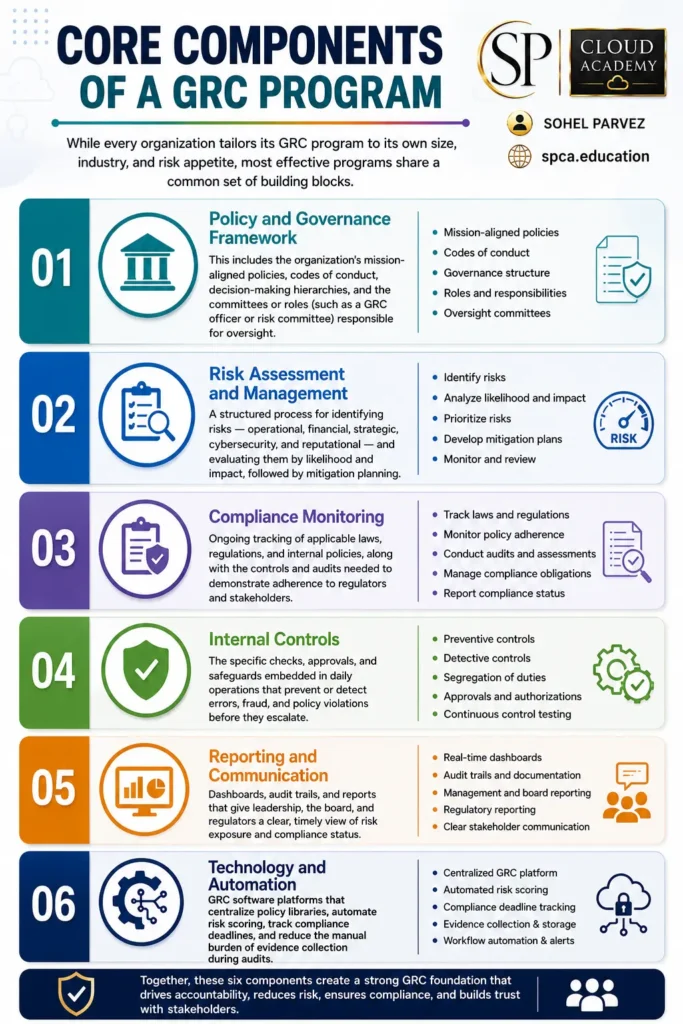
While every organization tailors its GRC program to its own size, industry, and risk appetite, most effective programs share a common set of building blocks.
1. Policy and Governance Framework
This includes the organization’s mission-aligned policies, codes of conduct, decision-making hierarchies, and the committees or roles (such as a GRC officer or risk committee) responsible for oversight.
2. Risk Assessment and Management
A structured process for identifying risks — operational, financial, strategic, cybersecurity, and reputational — and evaluating them by likelihood and impact, followed by mitigation planning.
3. Compliance Monitoring
Ongoing tracking of applicable laws, regulations, and internal policies, along with the controls and audits needed to demonstrate adherence to regulators and stakeholders.
4. Internal Controls
The specific checks, approvals, and safeguards embedded in daily operations that prevent or detect errors, fraud, and policy violations before they escalate.
5. Reporting and Communication
Dashboards, audit trails, and reports that give leadership, the board, and regulators a clear, timely view of risk exposure and compliance status.
6. Technology and Automation
GRC software platforms that centralize policy libraries, automate risk scoring, track compliance deadlines, and reduce the manual burden of evidence collection during audits.
Popular GRC Frameworks and Standards
Organizations rarely build a GRC program from scratch. Instead, they adopt or adapt established frameworks that provide a proven structure for governance, risk, and compliance activities. The table below outlines some of the most widely used frameworks.
| Framework | Primary Focus | Best Suited For |
| COSO | Internal control and enterprise risk management | Financial reporting, internal audit, SOX compliance |
| COBIT | IT governance and management | Aligning IT strategy with business goals |
| ISO 31000 | General risk management principles | Organizations of any size or sector |
| ISO 27001 | Information security management | Data protection, cybersecurity compliance |
| NIST CSF | Cybersecurity risk framework | Critical infrastructure, U.S. federal-aligned enterprises |
| GDPR / Data Privacy Regulations | Data privacy and protection compliance | Organizations handling personal data in the EU and globally |
Most organizations end up using more than one framework in combination — for example, pairing ISO 27001 for information security with COSO for broader enterprise risk management — rather than relying on a single standard to cover every requirement.
Benefits of Implementing a Strong GRC Program
- Reduced risk exposure. Proactive identification of risks means fewer surprises and faster response when issues arise.
- Improved decision-making. Leadership gains a consolidated, accurate view of organizational risk and compliance status, enabling faster and more confident decisions.
- Regulatory confidence. A well-documented GRC program simplifies audits, reduces the likelihood of fines, and demonstrates due diligence to regulators.
- Operational efficiency. Integrating governance, risk, and compliance activities eliminates duplicated effort across departments and reduces administrative overhead.
- Stronger stakeholder trust. Customers, investors, and partners are more willing to engage with organizations that can demonstrate strong governance and risk discipline.
- Better resilience. Organizations with mature GRC programs recover faster from disruptions because response plans and accountability structures are already in place.
Common Challenges in GRC Implementation
Building an effective GRC program is rarely straightforward. Most organizations encounter a similar set of obstacles along the way.
- Siloed departments that manage risk, compliance, and governance independently, leading to duplicated work and blind spots.
- Manual, spreadsheet-based processes that cannot keep pace with the volume and complexity of modern regulatory requirements.
- Limited executive buy-in, which starves GRC initiatives of budget, staffing, and authority.
- Rapidly evolving regulations, especially around data privacy and cybersecurity, that outpace internal policy updates.
- Difficulty measuring ROI, since the value of GRC often shows up as risks avoided rather than revenue generated.
- Inconsistent risk terminology and scoring methods across business units, making enterprise-wide risk comparison difficult.
How to Build a GRC Program: A Step-by-Step Approach
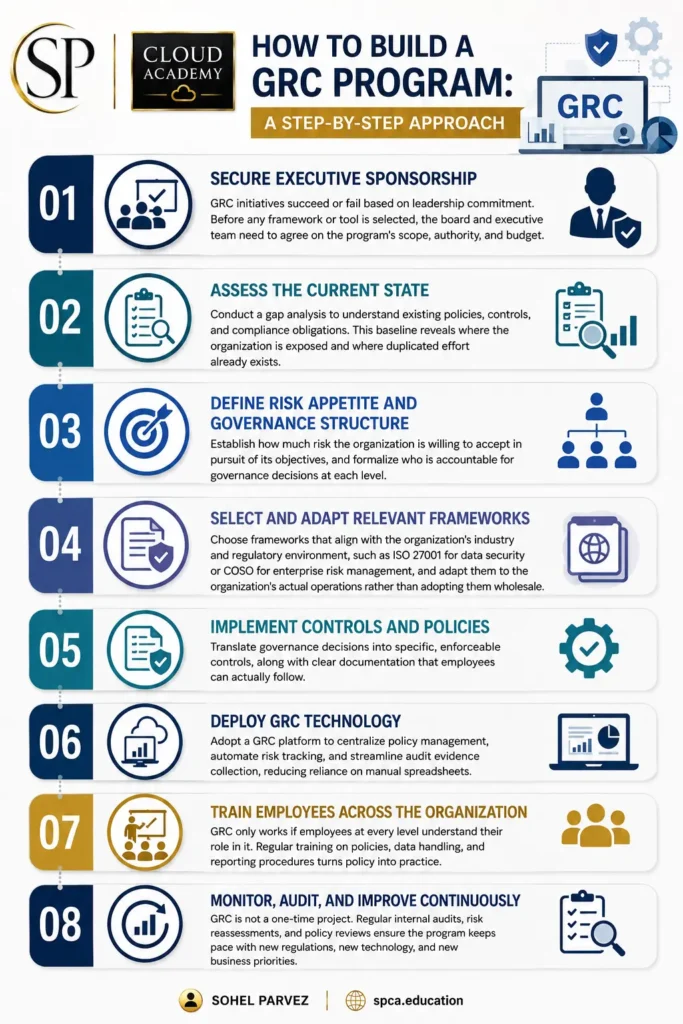
Step 1: Secure Executive Sponsorship
GRC initiatives succeed or fail based on leadership commitment. Before any framework or tool is selected, the board and executive team need to agree on the program’s scope, authority, and budget.
Step 2: Assess the Current State
Conduct a gap analysis to understand existing policies, controls, and compliance obligations. This baseline reveals where the organization is exposed and where duplicated effort already exists.
Step 3: Define Risk Appetite and Governance Structure
Establish how much risk the organization is willing to accept in pursuit of its objectives, and formalize who is accountable for governance decisions at each level.
Step 4: Select and Adapt Relevant Frameworks
Choose frameworks that align with the organization’s industry and regulatory environment, such as ISO 27001 for data security or COSO for enterprise risk management, and adapt them to the organization’s actual operations rather than adopting them wholesale.
Step 5: Implement Controls and Policies
Translate governance decisions into specific, enforceable controls, along with clear documentation that employees can actually follow.
Step 6: Deploy GRC Technology
Adopt a GRC platform to centralize policy management, automate risk tracking, and streamline audit evidence collection, reducing reliance on manual spreadsheets.
Step 7: Train Employees Across the Organization
GRC only works if employees at every level understand their role in it. Regular training on policies, data handling, and reporting procedures turns policy into practice.
Step 8: Monitor, Audit, and Improve Continuously
GRC is not a one-time project. Regular internal audits, risk reassessments, and policy reviews ensure the program keeps pace with new regulations, new technology, and new business priorities.
The Role of Technology in Modern GRC
As organizations scale, manual GRC processes become unsustainable. Modern GRC platforms centralize risk registers, automate compliance tracking against regulatory changes, and generate real-time dashboards for leadership and auditors. Increasingly, artificial intelligence is being layered into these platforms to flag anomalies, predict emerging risks from historical data, and reduce the manual effort involved in evidence collection during audits.
Cloud-based GRC tools also make it easier for distributed and remote teams to collaborate on risk assessments and policy updates in real time, which has become essential as more organizations operate across multiple regions and regulatory jurisdictions.
GRC Trends Shaping 2026 and Beyond

- AI-driven risk intelligence. Machine learning models are increasingly used to detect patterns and predict risk events before they materialize, rather than relying solely on historical audits.
- Integrated ESG reporting. Environmental, social, and governance metrics are being folded into mainstream GRC programs as investors and regulators demand more transparency.
- Third-party and vendor risk management. As organizations rely more heavily on external vendors and cloud providers, GRC programs are expanding to cover the entire supply chain, not just internal operations.
- Continuous compliance monitoring. Point-in-time audits are giving way to continuous, automated monitoring that flags compliance drift as it happens.
- Convergence of cybersecurity and GRC. As cyber risk becomes one of the top enterprise risks, cybersecurity teams and GRC functions are increasingly working from the same risk registers and reporting structures.
Conclusion
Governance, Risk, and Compliance is no longer a specialized function tucked away in the legal or audit department. It is a strategic capability that shapes how confidently an organization can pursue growth, adopt new technology, and respond to disruption. Organizations that treat GRC as an integrated, ongoing discipline — rather than a once-a-year compliance exercise — are better positioned to earn stakeholder trust, avoid costly failures, and make faster, more informed decisions in an increasingly complex regulatory landscape.
Whether an organization is just beginning to formalize its GRC approach or looking to modernize an existing program with better tools and automation, the fundamentals remain the same: align governance with strategy, understand risk before it becomes a crisis, and build compliance into daily operations rather than bolting it on after the fact.

Frequently Asked Questions
What does GRC stand for?
GRC stands for Governance, Risk, and Compliance — an integrated approach to managing organizational direction, risk exposure, and regulatory adherence.
Is GRC only relevant to large enterprises?
No. While large enterprises often have dedicated GRC teams, small and mid-sized organizations benefit just as much from having clear governance structures, basic risk assessments, and documented compliance processes, even if managed by a smaller team.
What is the difference between risk management and GRC?
Risk management is one component of GRC. GRC also includes governance, which sets organizational direction and accountability, and compliance, which ensures adherence to external laws and internal policies.
How does GRC relate to cybersecurity?
Cybersecurity is one of the most significant risk categories that a GRC program manages. Frameworks like ISO 27001 and NIST CSF are often used specifically to govern and assess cybersecurity risk within a broader GRC program.
See Also
-

Governance, Risk & Compliance (GRC): A Complete Guide for Modern Organizations
-

Vendor Lock-In vs. Business Freedom: The Ultimate Guide to Making Smarter Tech Decisions
-

Mastering IT Incident Response: A Comprehensive Framework for Corporate Security
-

Why Job-Related SOPs Are the Secret Weapon of Top IT Teams
-

Industry-Academia Collaboration: A Gateway to Unlocking Career Opportunities
-
The Evolution of IT Policies: What Every Organization Needs to Know for 2025
-

Unlocking Success: How the OKR Framework Can Transform Your Business
-

SMART Rules: A Complete Guide to Goal Setting and Achieving Success
-

Data Backup Policy