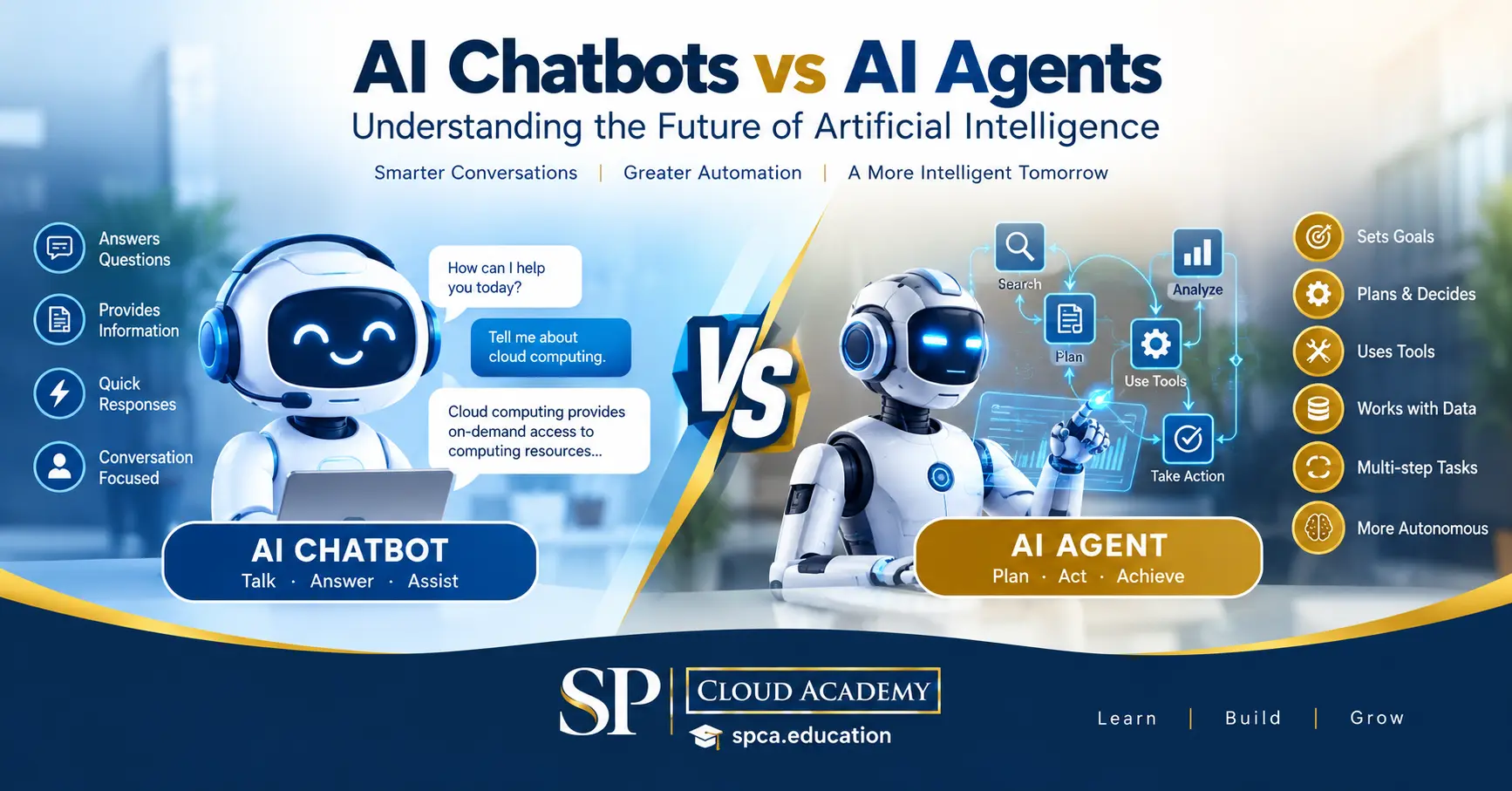
Introduction: Why the Difference Matters
Imagine you ask an AI system, “Which of our ten main competitors changed their pricing this quarter?” A chatbot will usually respond with an explanation, a summary of what it knows, or advice on how to find the answer. An AI agent, given the right tools and permissions, can go further. It may search approved sources, collect the data, compare the results, draft a report, and ask you to approve it before saving it.
Both systems can be powered by the same kind of language model. What differs is the system built around that model. This is the heart of the AI chatbots vs AI agents debate, and it matters because the two are often treated as the same thing.
Conversational AI is now part of classrooms, help desks, and offices. At the same time, interest in agentic AI, meaning systems designed to pursue goals by planning and acting, is growing quickly. Choosing the wrong approach can mean paying for complexity you don’t need, or trusting a simple tool with work it was never built to do.
In this guide you will learn:
- What an AI chatbot is and how it works
- What an AI agent is and what makes it different from a model
- How their workflows compare, step by step
- Where each one fits across industries
- The risks, and how to manage them responsibly
- How to choose the right solution for your situation
What Is an AI Chatbot?
An AI chatbot is a software application that communicates with people through natural language, either text or voice. Its main purpose is conversation: answering questions, explaining ideas, drafting content, and guiding users toward information or support.
Rule-Based vs AI-Powered Chatbots
Early chatbots were rule-based. They followed scripted decision trees: if the user clicks “Track my order,” show the tracking form. They are predictable and cheap to run, but they fail when a user phrases something unexpectedly.
AI-powered chatbots interpret free-form language and generate responses rather than selecting from a fixed script. Many modern ones are built on large language models (LLMs). An LLM is a machine-learning model trained on large amounts of text so that it can predict and produce language that fits a given context.
How Chatbots Understand Prompts and Generate Responses
When you type a message, the chatbot receives your prompt, which is simply the input that tells the model what you want. The system combines it with relevant context, such as earlier messages in the conversation and any instructions set by the developer. The model then generates a response one piece of text at a time, based on patterns it learned during training.
This is why chatbots can sound fluent. It is also why they can be confidently wrong: producing plausible text is not the same as verifying facts.
Common Capabilities and Limitations
Chatbots are generally good at:
- Explaining concepts in different styles and levels
- Summarizing and rewriting text
- Answering frequently asked questions
- Drafting emails, outlines, and study materials
- Providing round-the-clock first-line support
They also have limits. They may produce incorrect or fabricated information, rely on outdated knowledge, reflect biases in their training data, and lose track of details in long conversations. Unless connected to other systems, a chatbot talks about work rather than doing it.
Examples Across Education, Support, and Business
- Education: A learning platform’s chatbot explains a topic, answers follow-up questions, or generates practice quizzes.
- Customer support: A website chatbot answers questions about delivery times, return policies, or product features.
- Business: An internal chatbot helps staff find policy information or summarizes a long document.
A Practical Example: A Student Asks About Cloud Computing
A student types: “Explain cloud computing like I’m a beginner.”
The chatbot might reply that cloud computing means using computing resources, such as servers, storage, and software, over the internet instead of owning and maintaining them yourself. It might compare this to using electricity from a utility rather than running your own generator. If the student replies, “Can you give me an example with a photo-sharing app?”, the chatbot adapts the explanation.
Notice the pattern: the student asks, the chatbot answers, and the student steers the next step. The user drives the conversation.
What Is an AI Agent?
An AI agent is a system that uses AI, typically a language model, to work toward a goal. It can decide on steps, use tools, observe results, and adjust its approach. The key idea is not conversation but goal-directed action. The research field has used the word “agent” for decades for any system that perceives its environment and acts on it; today’s LLM-based agents are one modern version of that idea.
A Model Is Not an Agent
This is the most common source of confusion. An LLM on its own is a component that produces text. An agent system wraps that model in additional structure:
- Goal: the outcome the agent is trying to achieve
- Planning: breaking the goal into steps and deciding what to do next
- Tool use: calling external software, such as a search function, calculator, database query, or API (an API is a defined way for one program to request services from another)
- Context and memory: keeping track of the task, intermediate results, and sometimes information from previous sessions
- Feedback: checking results and deciding whether to continue, retry, ask for help, or stop
Working With Approved Tools and Data
An agent’s reach depends on what it is connected to. In a well-designed system, it can use only approved software, APIs, and databases, with permissions matched to its job. A research agent might read public web pages and write to a shared folder. It should not be able to delete company records or send payments.
Autonomy Is a Design Choice
Autonomy is not built into the word “agent.” It depends on how the system is designed, which permissions it holds, and which safeguards surround it. Some agents act fully within a narrow, low-risk task. Others stop and ask a person to approve every consequential step.
It is also worth stating plainly that not every agent uses every component. A simple agent may have tools but no long-term memory. Another may plan well but have just one tool. And none of them “think” like a human; they follow the instructions, models, and tools they were given.
How AI Chatbots and AI Agents Work
The Typical Chatbot Workflow
- User input: The person asks a question or gives an instruction.
- Context processing: The system combines the message with conversation history and developer instructions.
- Response generation: The model produces an answer.
- User feedback: The person reacts, corrects, or asks a follow-up, and the cycle repeats.
The Typical Agent Workflow
- Goal: The user or system sets an objective.
- Planning: The agent decides which steps are needed.
- Tool selection: It chooses a suitable tool for the next step.
- Action: It uses the tool.
- Observation: It reads the result.
- Evaluation: It checks whether the result moves it closer to the goal.
- Next action or completion: It continues, changes course, or finishes.
This pattern of reasoning and acting in alternating steps has been explored in published research, such as the ReAct approach, which combines language-model reasoning with actions in external environments.
A Simple Diagram
CHATBOT
User question --> Context --> Model response --> User feedback
      ^                                               |
      +-----------------------------------------------+

AI AGENT
Goal --> Plan --> Choose tool --> Act --> Observe --> Evaluate
          ^                                              |
          |         (not done: revise plan or retry)     |
          +----------------------------------------------+
                                                         |
                              (done, or needs approval) --> Result / Human review
Real systems are messier than any diagram. Agents may repeat steps, change their plans, ask clarifying questions, or pause for human approval before doing anything with real-world consequences.
AI Chatbots vs AI Agents: Key Differences
| Feature | AI Chatbot | AI Agent |
|---|---|---|
| Primary purpose | Conversation, information, and support | Achieving a goal through action |
| Interaction style | Turn-by-turn dialogue | Goal-driven; may work between user messages |
| Task execution | Usually describes or drafts; the user acts | Can carry out steps through connected tools |
| Planning | Limited or implicit | Explicit planning and re-planning |
| Tool use | Optional and often limited | Central to the design |
| Memory and context | Mostly conversation context | Task state, intermediate results, sometimes long-term memory |
| Decision-making | Mainly about what to say | Also about what to do next |
| Multi-step workflows | Often user-driven | Designed to manage them |
| Level of autonomy | Low; waits for the user | Varies from low to high, by design |
| Human supervision | Reviews answers as needed | Approval gates and monitoring, especially for critical actions |
| Typical use cases | FAQs, tutoring, drafting, first-line support | Research, workflow automation, data processing, IT tasks |
| Complexity and cost | Generally simpler and cheaper | Generally more complex to build, test, and maintain |
Reading the Table Carefully
The table shows tendencies, not laws. A chatbot answers; an agent is built to do something with the answer. A chatbot’s value is in the quality of its conversation. An agent’s value is in whether the task actually gets completed correctly.
Costs follow the same logic. An agent may make many model calls and tool calls for a single task, which can raise cost and response time. It also needs more testing, monitoring, and maintenance, because it interacts with other systems that can change or fail.
The Line Is Not Absolute
A chatbot can use tools, such as looking up an order status, and can complete multi-step tasks. An agent can have a chat interface. The distinction depends on system architecture and capability, not on what the product is called. A useful question to ask is: Does this system only talk about the task, or can it plan and act within defined limits?
Practical Examples: The Same Task, Two Approaches
All scenarios below are hypothetical illustrations.
Scenario 1: Customer Service and Order Management
Chatbot approach: A customer asks where their order is. The chatbot explains the delivery policy and, if it has a lookup tool, reports the tracking status. It answers questions about refund rules.
Agent approach: The customer says the item arrived damaged. An agent system checks the order record, confirms the delivery date, compares the case with the refund policy, prepares a refund request, and routes it for approval.
Human intervention: A staff member should approve refunds above a set threshold, handle unusual or disputed cases, and review any decision that affects money or customer rights.
Scenario 2: Researching Competitors and Preparing a Report
Chatbot approach: A manager asks, “What should I look for when comparing competitors?” The chatbot suggests criteria, such as pricing, features, and customer reviews, and can help draft a template.
Agent approach: The manager asks for a comparison of ten named competitors. The agent searches approved sources, gathers information, flags gaps, organizes findings into a table, and drafts a report in an approved location.
Human intervention: A person should verify key facts against the original sources, since agents can misread pages or rely on weak sources, and should decide what conclusions to draw.
Scenario 3: Education and Personalized Learning
Chatbot approach: A learner asks for an explanation of networking basics and gets a clear answer, an analogy, and a short quiz on request.
Agent approach: A learning-platform agent reviews a learner’s quiz history, identifies weak topics, selects suitable practice material from the course library, and proposes an updated study plan.
Human intervention: Educators should review the learning goals, check the quality of recommendations, and decide on assessment and grading. Student data must be handled according to privacy rules.
AI Chatbots vs AI Agents vs AI Assistants
An AI assistant is a broad term for a system that helps a user accomplish tasks, such as drafting text, scheduling, searching, or answering questions. Assistants usually have a conversational interface, and many include tools. Some behave mainly like chatbots; others contain agent-like capabilities.
These categories overlap. A single product might offer a chat window (chatbot), connect to your calendar (assistant), and carry out a multi-step booking workflow (agent behavior).
| Category | Core idea | Typical example |
|---|---|---|
| AI chatbot | Conversation-centered interaction | A website FAQ bot or a tutoring chat |
| AI assistant | Helps a user complete everyday tasks | A writing helper that also checks your calendar |
| AI agent | Pursues a goal through planning and tool use | A research system that gathers sources and drafts a report |
Treat these as points along a spectrum rather than separate boxes.
Real-World Applications Across Industries
Education and digital learning. Chatbots answer student questions and generate practice material. Agent systems can track progress, assemble resources, and help build learning paths, with educators supervising.
Customer service and e-commerce. Chatbots handle common questions. Agents can check orders, start returns, and route cases, ideally with approval steps for refunds or account changes.
Healthcare administration. Chatbots can answer scheduling or general-information questions. Agents may help with administrative workflows such as organizing documents. These settings involve highly sensitive data and strict regulation, so they require privacy safeguards, appropriate authorization, and review by qualified professionals. AI should not be treated as a substitute for clinical judgment.
Finance and accounting. Chatbots can explain terms or policies. Agents may assist with reconciling records or preparing draft reports. Because errors carry real cost, expert review, audit trails, and tight access control are essential.
Software development and IT operations. Chatbots explain code and suggest debugging steps. Agents can read a codebase, propose changes, run tests, and report results in an approved environment, with developers reviewing the output before anything is deployed.
Research, marketing, and business intelligence. Chatbots help brainstorm and summarize. Agents can collect data from approved sources, organize it, and prepare analysis, while people verify sources and interpret the findings.
Cloud computing and enterprise automation. Agents may help with tasks such as reviewing configurations or coordinating routine operational workflows. Permissions must be narrow, and consequential changes should require human approval.
Benefits and Limitations
Chatbot Benefits
- Accessible information: Anyone can ask in plain language.
- Fast responses: Answers arrive in seconds.
- Consistent support: The same policies can be applied across conversations.
- Scalable communication: One system can serve many users at once.
Agent Benefits
- Multi-step workflow execution: Several steps can be managed toward one outcome.
- Reduced repetitive work: Routine tasks can be delegated.
- Tool-assisted data processing: Agents can combine model reasoning with calculators, databases, and search.
- Coordination across approved systems: Information can move between tools without manual copying.
Limitations That Affect Both
- Incorrect or fabricated outputs, sometimes called hallucinations
- Outdated or incomplete information
- Bias and inconsistent performance across topics, languages, or phrasing
- Privacy and security risks
- Tool failures and integration complexity
- Cost, latency, monitoring, and maintenance
- Excessive permissions and unintended actions, which matter most for agents
The good news is that these risks are manageable. Thorough testing reveals weak spots before launch. Restricted permissions limit the damage any mistake can cause. Human oversight catches consequential errors, and output verification (checking facts against trusted sources) protects quality.

Security, Ethics, and Responsible AI
Responsible use is practical engineering, not fear. These are the main areas to address.
Data privacy and access control. Decide what data the system may see and who may use it. Share only what the task requires, and follow applicable privacy laws and organizational policy.
Prompt injection and untrusted input. Prompt injection happens when text from an outside source, such as a web page or email, contains instructions that try to redirect the AI. Agents that read external content are especially exposed. Treat that content as data, not as commands, and limit what the agent can do after reading it. The OWASP project publishes guidance on this and related risks for LLM applications.
Least-privilege permissions. Give the agent only the access it needs, such as read-only access when writing is unnecessary.
Human approval for consequential actions. Payments, deletions, external messages, and changes to production systems should require sign-off.
Audit logs and monitoring. Record what the agent did and why, so problems can be traced and corrected.
Accountability and transparency. Make clear who owns the system, and tell users when they are interacting with AI.
Evaluation, testing, and incident response. Test on realistic scenarios, including failures. Have a plan for what to do when something goes wrong, including a way to pause or shut the system down. Frameworks such as the NIST AI Risk Management Framework offer structured approaches to identifying and managing AI risks.
How to Choose the Right Solution
Work through these questions in order.
- How complex is the task? A single question and answer suggests a chatbot. A process with many dependent steps suggests an agent.
- Is action required, or only information? If people just need explanations, a chatbot is usually enough. If something must be done in other systems, consider an agent.
- What tools and integrations exist? An agent is only as useful as the systems it can safely reach. Without them, there is little for it to do.
- How risky and reversible is the task? Drafting a summary is low risk. Sending money is not. The less reversible the action, the more human approval it needs.
- What are the budget and maintenance capacity? Agents typically cost more to build, run, and monitor.
- How accurate must results be, and who will review them? High-stakes work needs stronger verification regardless of the technology.
A basic chatbot is sufficient when the job is answering questions, tutoring, or drafting, and no actions are required.
An agent is appropriate when the task has repeatable multi-step steps, available tools, clear success criteria, and manageable risk.
A hybrid system is often best. A chatbot handles the conversation, and an agent component takes over for specific tasks, such as checking an order, with approval gates where needed. A sensible starting point is the simplest design that meets the need; add agent capabilities only where they clearly help.
The Future of Artificial Intelligence
It helps to separate what exists today from what is still emerging.
Tool-using AI systems. Connecting models to tools is already common. Open standards, such as the Model Context Protocol, aim to make these connections more consistent. Reliability and security remain active areas of work.
Multimodal interfaces. Systems that handle text, images, audio, and other inputs are increasingly available, which may make interacting with both chatbots and agents more natural.
Human-agent collaboration. A likely direction is people setting goals and reviewing results while agents handle routine steps. This is an expectation, not a guarantee.
Agent orchestration and specialized agents. Some designs use several specialized agents coordinated by a manager component. This can be powerful but adds complexity and new failure points.
Evaluation, governance, and trustworthy automation. Better testing methods, clearer standards, and stronger oversight will probably determine how widely agents can be trusted in sensitive settings.
No one can predict exactly how these trends will unfold. What seems reasonable is that AI systems will take on more routine, well-defined tasks, while people stay responsible for judgment, ethics, and accountability. Claims that agents will replace all human workers are not supported by evidence.
Frequently Asked Questions
What is the main difference between an AI chatbot and an AI agent? A chatbot focuses on conversation and answers. An agent is designed to pursue a goal by planning, using tools, and taking actions.
Can an AI chatbot become an AI agent? Yes. Adding planning, tool access, memory, task tracking, and result checking can make a chatbot behave like an agent.
Are AI agents more intelligent than chatbots? Not necessarily. Both may use the same underlying model. Agents are better described as more capable in action, not more intelligent.
Do AI agents work without human supervision? It depends on the design. Some handle low-risk tasks with little supervision, but consequential actions should have human approval and monitoring.
Can AI agents use external tools and APIs? Yes, when developers connect them. Access should be limited to approved tools with the minimum necessary permissions.
What are the best applications of AI chatbots? FAQs, customer support, tutoring, drafting and summarizing, and internal knowledge lookup.
What are the most common AI agent use cases? Research and report preparation, workflow automation, data processing, IT and software tasks, and multi-step customer service processes.
Are AI agents safe for business use? They can be used responsibly with limited permissions, testing, logging, human approval for critical actions, and ongoing monitoring. Safety depends on design and governance.
What is the difference between an AI assistant and an AI agent? An assistant is a broad category of systems that help users with tasks. An agent emphasizes goal-directed planning and action. They overlap, and many assistants include agent features.
Which is better for students and businesses: an AI chatbot or an AI agent? Students mostly benefit from chatbots for explanations and practice. Businesses should choose based on the task: chatbots for information, agents for multi-step action, and hybrids for both.
Conclusion
The central distinction in AI chatbots vs AI agents is one of purpose. Chatbots emphasize conversational assistance. Agentic systems are designed to pursue goals through planning, tool use, and action. The line between them is blurry, and many real products combine both.
The practical lesson is to start from the need, not the label. Ask what outcome you want, what could go wrong, how reversible the action is, and who will check the result. A simple chatbot that does its job well is better than an agent that adds risk without adding value.
If you want to keep building your understanding of AI, cloud computing, and emerging technology, explore the learning resources at SP Cloud Academy.
See Also
-

Microsoft Copilot Is Changing Work Forever — Here’s How It Impacts You
-

AI Agents Explained: What They Are and How They’re Revolutionizing the Future of Work
-
Is Gamma.app the Future of Presentations? A Brutally Honest Review
-
The Rise of Smart Enterprises: Inside the New Era of AI-Driven Business
-

Grok 3 Unleashed: The Next AI Revolution You Can’t Ignore!
-

AI and Human Collaboration: The Future of Work, Creativity, and Innovation
-
Unlocking AI’s Full Potential with Context-Based Prompting: A Complete Guide
-

Mastering Instruction-Based Prompting: The Secret to Unlocking AI’s Full Potential
-

How to Use ChatGPT for Business Research: Unlock Industry Trends & Create Winning Business Plans