
The classroom is no longer defined by four walls and a chalkboard. As educational institutions face rising expectations around engagement, accessibility, and measurable learning outcomes, blended teaching — the deliberate integration of face-to-face instruction with digital learning environments — has moved from experimental practice to institutional necessity. The differentiator is rarely pedagogical will; it is infrastructure. Institutions that invest thoughtfully in IT hardware and software do not merely digitize their classrooms — they re-architect how knowledge is delivered, absorbed, and retained. This article examines why that investment matters and outlines the technology stack that makes it possible.
Why IT Infrastructure Changes Learning Outcomes
The value of technology in blended teaching is not decorative. Six distinct mechanisms explain why well-implemented IT products produce measurably better classroom outcomes.
Simulated Environments Deepen Conceptual Understanding
Virtual simulations and interactive multimedia allow students to manipulate abstract or hazardous concepts — from molecular structures to historical events — in a controlled digital environment. This experiential layer converts passive reception into active exploration, which correlates strongly with retention.
Complex Content Becomes Digestible
Multimedia presentations, interactive diagrams, and visual aids give educators the means to decompose dense material into sequenced, manageable units. Rather than compressing a topic into a single lecture, instructors can layer explanation, visualization, and application — improving both comprehension and the speed of learning.
Engagement Drives Academic Performance
Interactive quizzes, gamified platforms, and structured online discussion shift students from spectators to participants. The resulting increase in engagement is not merely motivational — it is directly linked to improved academic performance, as active participation reinforces recall and application of material.
Collaborative Tools Build Workforce-Ready Skills
Online platforms, discussion forums, and shared documents extend collaboration beyond the physical classroom. This mirrors the distributed, asynchronous teamwork increasingly expected in professional environments, making collaborative IT tools as much a career-readiness investment as a pedagogical one.
Digital Access Expands the Knowledge Base
Where a traditional classroom is bound by its textbook, a connected one is bound only by the internet’s scope. Students gain access to primary sources, current data, and diverse perspectives — resources that keep instruction current in fields where information changes faster than curricula can be revised.
A More Enjoyable Learning Process Sustains Motivation
Multimedia content, interactive games, and personalized learning paths introduce variety and challenge calibrated to the learner. The resulting positive affect is not incidental — sustained motivation is one of the strongest predictors of long-term academic persistence.
Tell me and I forget. Teach me and I remember. Involve me and I learn.
— Benjamin Franklin
The Hardware Foundation
Effective blended teaching depends on a coherent hardware layer — not an accumulation of gadgets, but a deliberately specified set of tools that support presentation, interaction, and communication in tandem.

| Hardware | Function |
| PC | Serves as the operational base for running instructional software and accessing online resources. |
| Smart Interactive Board | Enables dynamic, touch-based presentation and real-time collaborative annotation with students. |
| Projector | Displays multimedia and interactive content at classroom scale, ensuring uniform visibility. |
| Wireless Presenter | Allows instructors to navigate presentations while remaining mobile within the room. |
| Web Camera | Supports video conferencing and remote collaboration with off-site students or guest instructors. |
| Writing Tablet with Stylus | Provides a digital surface for note-taking, diagramming, and problem-solving. |
| Sound System | Ensures clear audio delivery for instruction and multimedia playback across the room. |
| Tablet with Stylus | Offers a portable, annotatable surface for interacting with digital course content. |
The Software Ecosystem
Hardware provides the delivery mechanism; software determines what is actually taught, tracked, and reinforced. A mature blended-learning environment typically draws on ten categories of platforms, each addressing a distinct instructional function.

Local Hosting: Control Before Deployment
For institutions developing or testing platforms such as WordPress or Moodle, local hosting — running the application on a server within the institution’s own environment — offers a controlled staging ground. It allows development and configuration to proceed without exposure to external servers, improving security, control, and iteration speed before a public rollout. WordPress and Moodle both offer local-hosting installers suited to this purpose.
Conclusion
Blended teaching is not achieved by layering software onto an unchanged classroom; it is achieved by treating hardware and software as a single, coordinated system designed around specific learning outcomes. Institutions that approach the investment this way — matching interactive boards to collaborative platforms, tablets to annotation software, video conferencing to learning management systems — convert technology from a cost center into a durable instructional advantage. The tools outlined here are not the endpoint of that effort, but the foundation on which a genuinely modern classroom is built.
See also
-
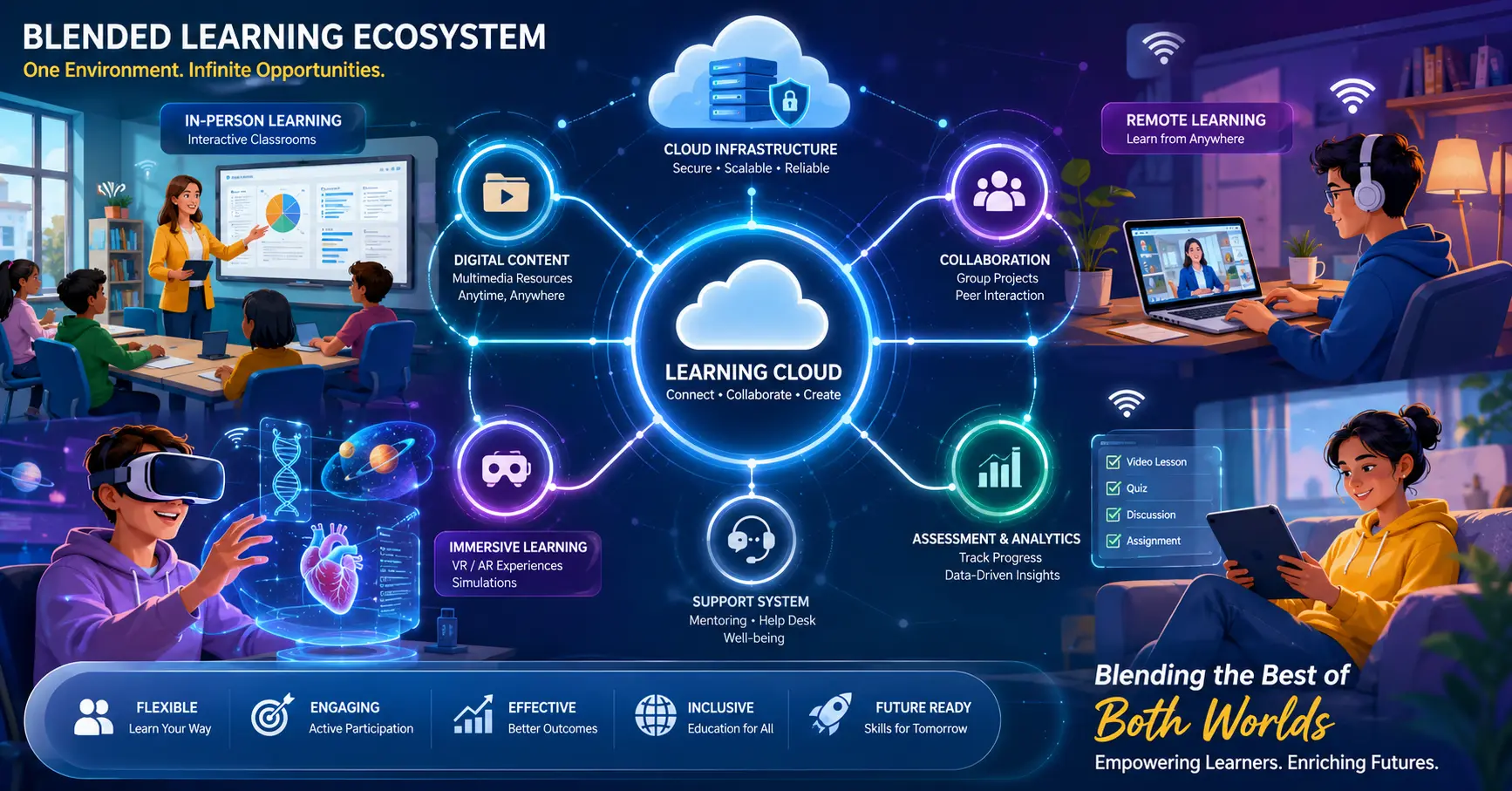
THE COMPLETE BLENDED LEARNING ECOSYSTEM
-

The Ultimate Guide to Developing an E-Learning Studio for Engineering Institutes: From Planning to Production
-

How Smartphones Are Transforming Blended Teaching into a Classroom Superpower!
-

From Desktop to Cloud: The Revolutionary Shift That’s Making Physical Computing Labs Obsolete in 2025
-
Master Google Classroom Like a Pro: The Complete Training Guide for Teachers
-
Revolutionizing LMS: How Simulation & Virtual Tech Are Changing Online Learning Forever